The scrutiny period for the UK–EU Agreement in respect of Gibraltar closed on 22 October 2026, clearing the way for UK ratification. The House of Lords European Affairs Committee had reported the Agreement for the special attention of the House, and peers debated it on 20 October. The European Parliament’s consent is still awaited. Meanwhile the Agreement has been applying provisionally since 15 July 2026 under Article 336(2), and the physical barriers at the frontier with Spain have been coming down.
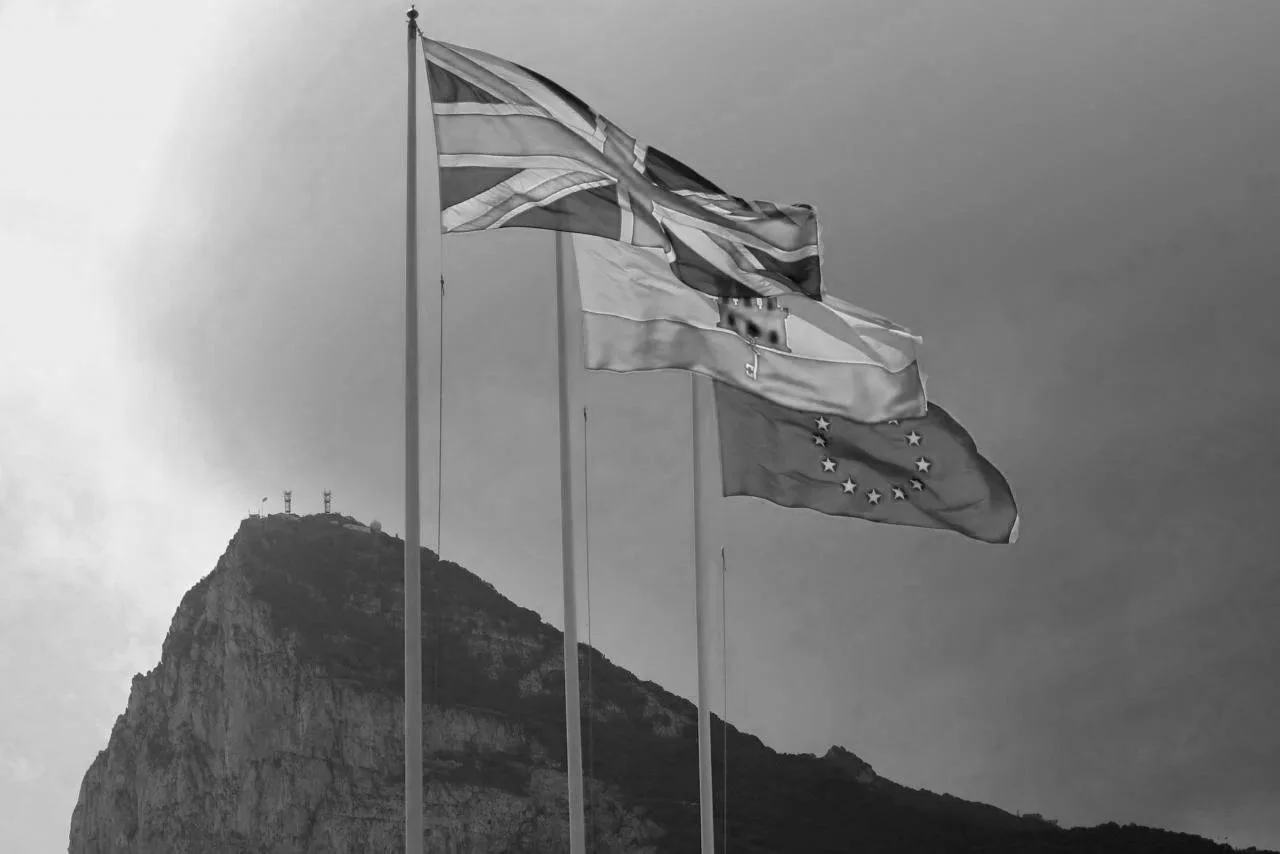
That makes this a good moment to take notice of something that has attracted less attention than it deserves. Brexit created three new external borders of the European Union in places where the border is itself contested: the land border on the island of Ireland, the frontier between Gibraltar and Spain, and the boundary between the UK Sovereign Base Areas in Cyprus (SBAs) and the Republic of Cyprus. In each case, the UK’s EU membership had rendered that border largely invisible. In each case, its withdrawal threatened to make it visible again, and with it to unsettle a political settlement built on its absence.
The EU and the UK responded to all three with the same three legal techniques. That recurrence is not a coincidence. It tells us something about how the Union manages disintegration.
The reverse case
We know a good deal about how integration affects border conflicts. Diez, Stetter and Albert showed that the EU’s impact is strongest where there is a credible membership perspective and weaker in situations of association. Visoka and Doyle captured the Union’s characteristic method in the concept of ‘neo-functional peace’: the EU deconstructs highly political questions into technical ones, so that agreement in areas of ‘low politics’ can build confidence and eventually spill over into sovereignty itself.
What that literature does not address is the reverse case. It assumes a relationship between the Union and the conflict parties that is either static or deepening. The possibility that a Member State might leave — and what that would mean for the contested borders on its territory — was not in view. Brexit raised this question with regard to three sensitive borders. The three post-Brexit regimes that regulate them turn out to share a common architecture, and reading them together reveals a toolkit for managed disintegration.
Technique one: sovereignty disclaimers
Each instrument contains a provision quarantining the underlying territorial dispute from the operational arrangements. What is striking is how the sophistication of these disclaimers tracks the intensity of the dispute they insulate.
In the SBAs in Cyprus, where the 1960 Treaty of Establishment settled sovereignty and that debate has since been largely muted, the Withdrawal Agreement Protocol contains no standalone disclaimer. Its Preamble simply refers back to the Treaty of the Establishment. Nor does it need one: the whole architecture — from the Treaty of Establishment, through Protocol No 3 to the 2003 Act of Accession, to the Withdrawal Agreement Protocol — functions as one continuous sovereignty disclaimer, normalised by decades of practice.
In Northern Ireland, Article 1(1) of the Protocol anchors the arrangement in the 1998 Belfast/Good Friday Agreement and the principle of consent. The disclaimer is not freestanding: it borrows its authority from an existing constitutional settlement.
In Gibraltar, where two states actively contest sovereignty, the disclaimer reaches its most elaborate form. Article 2 provides that the Agreement on Gibraltar and everything done under it is without prejudice to the respective positions of the UK and Spain, and shall not constitute the basis for any assertion or denial of sovereignty. The symmetry matters in a context where operational arrangements could be read as implying either UK sovereignty or Spanish authority. And the protection extends into the dispute settlement machinery: Article 301(2)(a) excludes Article 2 from the covered provisions, Article 301(6) bars the arbitration tribunal from deciding any sovereignty question once a party objects, and a separate disclaimer attaches to the isthmus on which Gibraltar airport sits.
How much work that clause does, is visible in the ratification debate. Before the Gibraltar Parliament voted on the Agreement in March, the Chief Minister published three legal opinions — by Sir Peter Caruana, Jamie Trinidad and Lord Pannick — each addressing whether anything in it undermined UK sovereignty or jurisdiction. All three said no. The disclaimers do not resolve anything. They freeze the contested question so that everything else can proceed, and so that the politics of ratification can proceed too.
Technique two: extraterritorial EU law
Freezing the sovereignty question creates political space; keeping the border ‘invisible’ requires EU law to continue applying beyond the Union’s territory. Here the negotiators disaggregated the acquis and applied only those elements needed to keep each particular border functionally open.
The selectivity is revealing. Northern Ireland gets EU customs law and a substantial body of single market legislation for goods, but not free movement of services. Gibraltar gets a Schengen-like regime for persons and a customs union. The SBAs in Cyprus get customs, indirect taxation and agriculture, and nothing more. As Weatherill has observed of the Northern Ireland arrangement, this demonstrates the ‘negotiable character’ of internal market integrity: the scope of the acquis treated as essential is itself a product of political bargaining.
But ‘invisibility’ of the borders needs qualifying. Komarova and Hayward argue that what matters about border regimes is not inclusion or exclusion across a state border but hierarchies of rights and treatment within a jurisdiction. On that view, a border does not disappear when its infrastructure does; it is redistributed. The three regimes bear this out. Each keeps the contested frontier clear of physical barriers precisely by creating such hierarchies — Northern Ireland’s dual regulatory position, the distinct status of Gibraltar’s residents and of the roughly 15,000 people crossing the land border each day, the differentiated treatment of those crossing the SBAs’ external boundaries. What these techniques achieve is not the erasure of the border but its displacement from the territorial line into the legal status of persons and goods.
Gibraltar produces the most arresting result. During membership, Article 28 of the UK Accession Treaty kept Gibraltar outside the Customs Union, VAT area and Common Agricultural Policy, and Spain’s objection over the isthmus blocked its inclusion in EU aviation instruments. The Agreement now establishes a customs union (Article 240) and provides for direct flights between Gibraltar and EU destinations, with a joint venture to run the airport. De-Europeanisation has unlocked cooperation that Europeanisation could not deliver — not because membership was incapable of it, but because the bilateral politics made it impossible.
Technique three: bespoke governance
Neither disclaimers nor extraterritorial application sustain themselves. Each regime therefore comes with institutional machinery, and the three sit at very different points on the intergovernmental–supranational spectrum.
Northern Ireland has governance of remarkable density: a Joint Committee, a Specialised Committee, a Joint Consultative Working Group, the democratic consent mechanism, the Stormont Brake, direct CJEU jurisdiction under Article 12, and the Article 16 safeguard clause. The SBAs, by contrast, preserve CJEU jurisdiction and Commission enforcement within a far lighter framework — no consultative body, no consent mechanism, no safeguard clause. Gibraltar sits somewhere else again: a Cooperation Council on the model of the EU-UK Trade and Cooperation Agreement, no direct CJEU jurisdiction, but a binding reference procedure where an arbitration tribunal confronts a question of EU law (Article 312). What unites them is that each governance structure is calibrated to reinforce the sovereignty disclaimer rather than to test it.
The alignment paradox
The most interesting divergence concerns how each regime keeps EU law current, and it inverts what one would expect. In the SBAs, Article 1(4) of the Protocol makes alignment wholly automatic: a reference to a Union act is read as a reference to that act as amended or replaced. The UK has no say. In Northern Ireland, Article 13(3) achieves the same automaticity for amending acts, tempered by the Stormont Brake, while Article 13(4) subjects genuinely new acts to Joint Committee agreement backed by ‘appropriate remedial measures’ that cannot take effect for at least six months. The sanction is graduated and proportionate.
Gibraltar alone gives the UK a formal choice. Under Article 19, the Union must notify the UK of any subsequent act, and the UK has 30 days to say whether it accepts and will implement it. That looks like the most autonomy-preserving of the three regimes. It is the opposite. Under Article 19(5), refusal — or silence, or failure to implement — means the Agreement ‘shall be considered terminated unless the Cooperation Council … decides otherwise within 90 days’, with termination taking effect three months later. Termination is the default. It requires a positive decision to avert, not a positive decision to impose. And it attaches to the whole instrument, not to the offending measure. So, the discretion Article 19 preserves, is real in form but close to unusable in practice: exercising it would collapse the architecture on which the fluidity of the frontier depends. Where the Northern Ireland Protocol disciplines divergence through calibrated procedures and proportionate remedies, the Gibraltar Agreement disciplines it through the threat of its own destruction. Depth of integration, it turns out, does not predict the severity of the alignment obligation — the narrowest regime is the most automatic, and the deepest carries the harshest sanction.
Termination is locked down from the other direction too. Article 66 allows either Party to terminate the whole Agreement after the evaluation of the provisions on persons, and obliges the Union to take steps towards termination if Spain asks. But the Gibraltar Parliament made its support conditional on a Concordat with the UK, signed on 14 July, under which the UK will not move towards termination — save in the most exceptional circumstances — without a three-quarters majority of the Gibraltar Parliament or a referendum. A treaty that is formally bilateral is therefore held in place by Spain at one end and by the Gibraltarian electorate at the other.
Northern Ireland offers a mirror image of the alignment point. In December 2024, 35 unionist members of the Northern Ireland Assembly sought to pull the Stormont Brake against an EU regulation on chemical labelling. On 20 January 2025, the Secretary of State declined, accepting that the procedures had been correctly followed but finding the substantive conditions unmet — partly because divergence in chemical labelling already existed and most affected businesses traded with the EU anyway. The existing fact of differentiation counted against arresting its deepening. Both regimes arrive at alignment; they simply take opposite routes.
Neo-functional peace, reversed
Read together, the three techniques cast a particular light back on Visoka and Doyle. They described the translation of political questions into technical ones as a mechanism of transformation, its value lying in the spillover it generates. The post-Brexit arrangements detach that mechanism from its teleology. The same technical translation is deployed not to move a conflict towards resolution but to stop disintegration reopening it.
Neo-functional peace, on this evidence, is less a theory of conflict resolution than a method of conflict management, capable of running in either direction. The EU’s contribution to managing contested borders does not end when a Member State leaves.
Two caveats are worth stating. First, the flexibility that makes accommodation possible is also a source of ambiguity, and ambiguity — as Hayward and Komarova argue of the Northern Ireland Protocol — shades into precariousness absent a stable UK–EU relationship. Second, none of this may be portable. These techniques are intelligible only against the backdrop of the acquis and the institutional sophistication of the EU legal order.
Still, the conclusion holds. For the foreseeable future, the borders of Northern Ireland, Gibraltar and the Sovereign Base Areas will continue to be shaped by Brussels — even from the outside.
This post was first published in the European Law Blog on 6 November 2026. It draws on the author’s article, ‘The Legal Architecture of De-Europeanisation: Managing Border Conflicts After Brexit’, JCMS: Journal of Common Market Studies (2026, Early View), which is available open access under a CC BY licence.